
Counter Doors Built for Frequent Use
Explore why replacement counter doors perform better as roll-up doors in high-use counter spaces with constant daily operation.
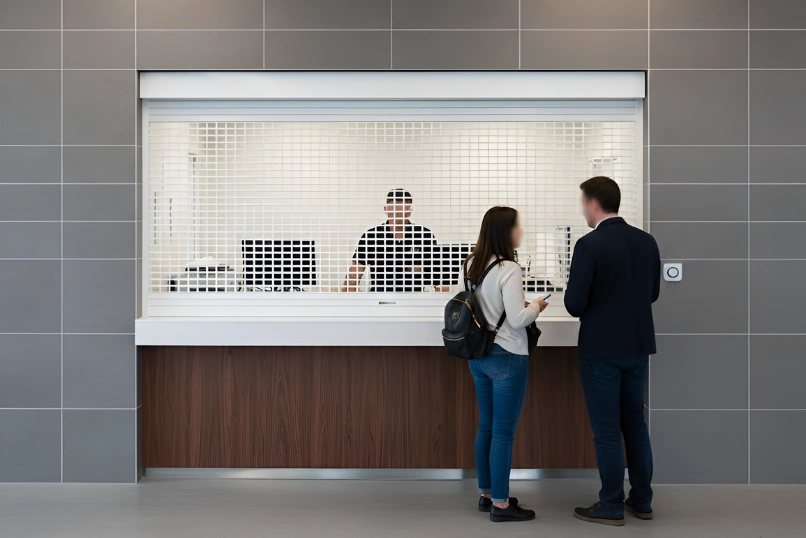
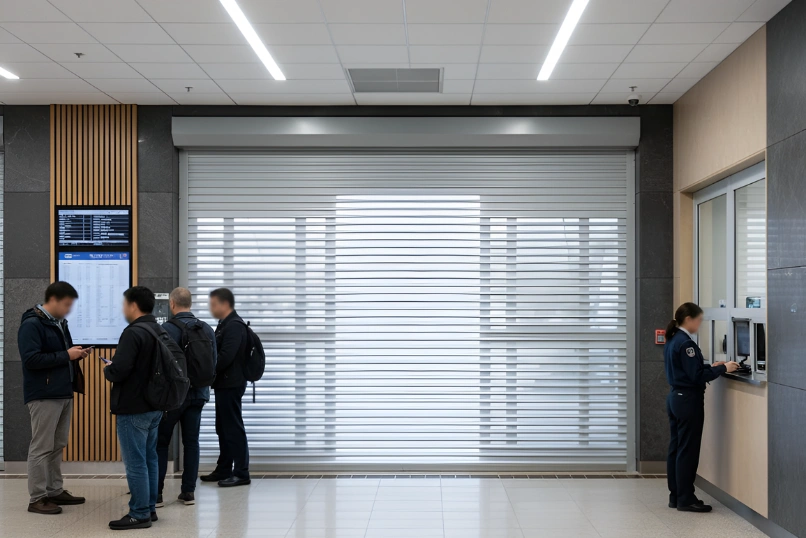
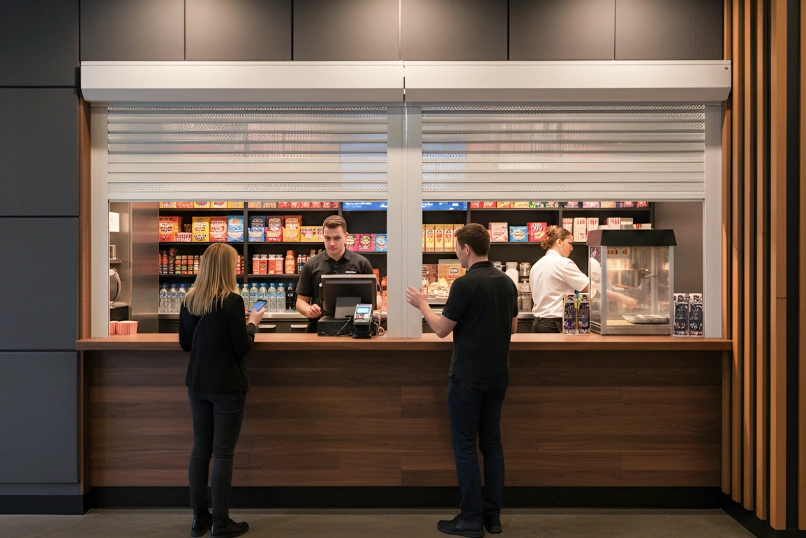
Replacement counter doors are used in service counters that require frequent access throughout the day. In high-use counter spaces, door performance affects workflow, space, and reliability. This article outlines common challenges in these environments, explains why roll-up operation fits better for counter door replacement, compares available options, and helps determine when this solution makes sense.
Best Roll-Up Counter Door for High-Use Service Areas
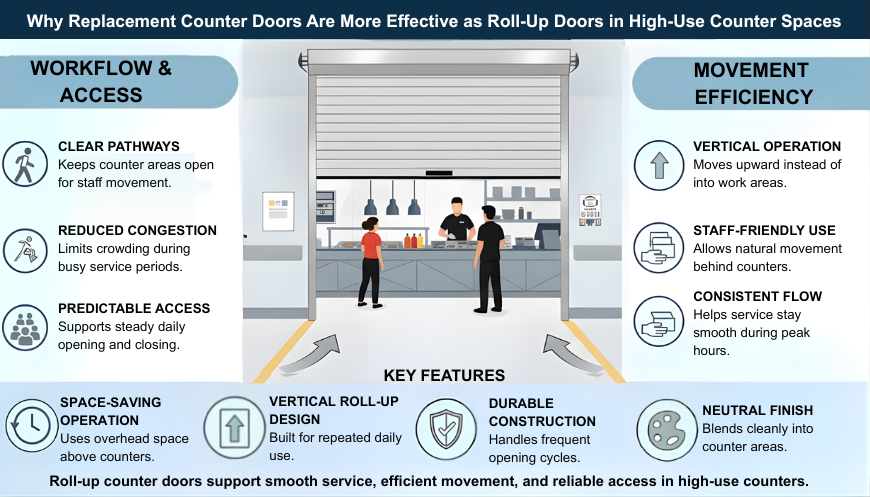
Choosing the right counter door can have a direct impact on daily operations. Compared to swinging or sliding options, roll-up counter doors require less clearance, operate faster, and handle frequent use more effectively. This comparison highlights how roll-up counter doors align better with high-use counter spaces, helping businesses maintain smoother workflows, reduce interruptions, and support consistent access throughout the day.
Challenges in High-Use Counter Spaces
High-use counter spaces place unique demands on doors that go far beyond occasional access. When doors are part of constant daily activity, even small limitations can quickly affect operations, staff movement, and reliability.
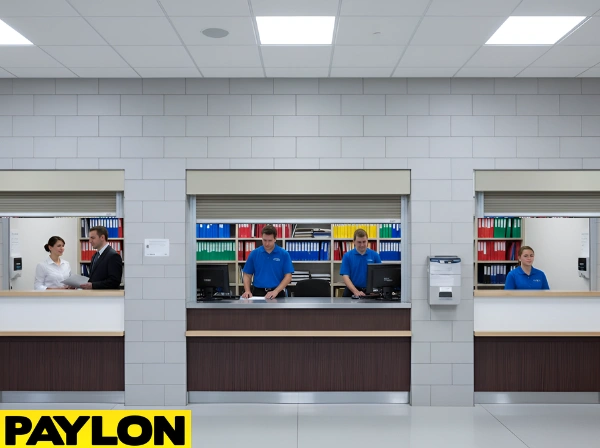
• Frequent opening and closing throughout the day creates strain. In busy service counters, doors are used repeatedly during peak hours. This constant motion increases stress on door components and can lead to inconsistent performance over time.
• Limited space behind service counters causes congestion. Counter areas often have tight layouts with little room for clearance. When space is restricted, door movement can interfere with staff flow and slow down routine tasks.
• Workflow interruptions during peak hours slow operations. During high-traffic periods, any delay at the counter becomes more noticeable. Small disruptions can stack up, affecting service speed and overall efficiency.
• Wear, damage, and access control issues develop over time. Frequent use can accelerate visible wear and operational issues. As these problems grow, maintaining reliable access and control becomes more challenging.
These challenges highlight why door performance matters so much in high-use counter environments. Understanding where traditional counter setups struggle helps set the stage for evaluating which door operations align better with daily demands.
Why Roll-Up Doors Work Better for Counter Door Replacement
Once the challenges of high-use counter spaces are clear, the next step is understanding how door operation affects daily use at a physical level. Roll-up doors function differently from other counter door types, particularly in how they move, store, and handle repeated motion.
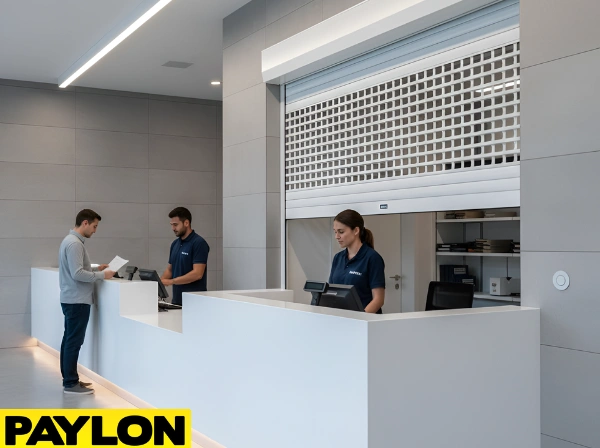
• Vertical operation keeps movement above the counter opening. Roll-up doors open upward and coil above the opening. This keeps the door’s movement contained overhead rather than extending into the counter area.
• Open and close motion avoids blocking staff paths. Because the door travels vertically, it does not swing outward or slide across adjacent space. This allows counter areas to remain clear while the door is in use.
• Door structure supports repeated daily cycles. Roll-up doors use a continuous curtain that wraps around a drum during operation. This structure is built to handle frequent opening and closing without relying on wide clearances or multiple panels.
• Operation remains manageable in tight or shared counter spaces. When open, the door stays within its own overhead footprint. This allows it to function consistently in areas where counter space is limited or shared across tasks.
Understanding how roll-up doors operate helps explain why this type of movement is often considered for counter door replacement in environments with constant daily use.
Key Benefits of Using Roll-Up Doors in High-Use Counters
When counter doors are used constantly throughout the day, performance is measured by how smoothly operations run over time. In high-use environments, the way a door functions translates directly into day-to-day outcomes that staff and customers both notice.
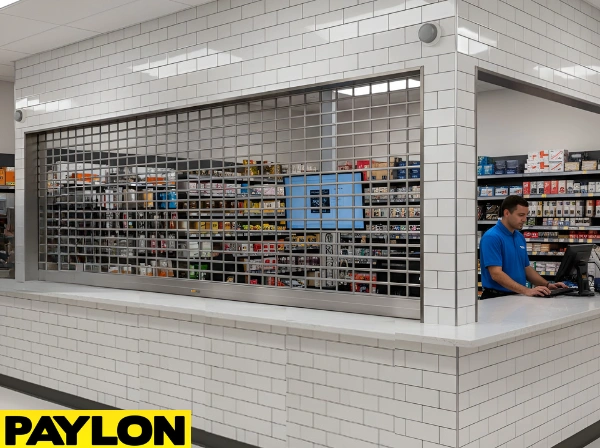
• Smoother workflow during busy service periods. High-traffic counters benefit from uninterrupted movement and predictable access. This helps service teams keep pace during peak hours without unnecessary slowdowns.
• Reduced downtime caused by wear or obstruction. Consistent performance lowers the chances of interruptions tied to door-related issues. Fewer disruptions mean counter areas can stay open and functional when they are needed most.
• Better use of limited counter space. Space around service counters remains more usable throughout the day. This allows staff to work more efficiently without adjusting routines to accommodate door movement.
• Consistent access control when counters are closed. Reliable closure helps maintain controlled access outside of service hours. This supports routine opening and closing schedules without added complexity.
Together, these outcomes reflect why roll-up doors are often associated with more dependable performance in high-use counter environments. The benefits become most noticeable over time, as daily operations remain steady even under frequent use.
Roll-Up Counter Doors vs Other Counter Door Options
With different counter door options available, comparing how each one fits daily use can help clarify which solution aligns best with high-use counter environments. The table below outlines key differences between common counter door types based on space, operation, and suitability for frequent use.
| Comparison Factor | Roll-Up Counter Doors | Swinging Counter Doors | Sliding Counter Doors |
|---|---|---|---|
| Space required | Uses overhead space above the opening | Requires clearance in front of or behind the counter | Requires wall space beside the opening |
| Speed of operation | Consistent vertical movement | Dependent on swing clearance and staff movement | Dependent on track length and travel |
| Suitability for frequent use | Designed for repeated daily operation | Can become restrictive with constant use | Tracks may limit performance under heavy use |
| Durability over time | Built to handle ongoing daily cycles | Hinges and frames may wear with frequent use | Rollers and tracks can wear over time |
| Ease of daily operation | Operates within its own footprint | Can interfere with nearby activity | Requires a clear track path to function smoothly |
This comparison highlights how counter door options differ in practical terms. Reviewing these distinctions can help decision-makers better assess which door type fits the realities of high-use counter environments before moving into more specific questions.
Frequently Asked Questions
FAQs About Replacement Counter Doors and Roll-Up Counter Doors
What is a replacement counter door?
A replacement counter door is a door installed at a service counter or pass-through opening to control access during operating and non-operating hours.
What is a roll-up counter door?
A roll-up counter door is a type of replacement counter door that opens vertically and stores above the counter opening.
Where are replacement counter doors commonly used?
Replacement counter doors are commonly used in retail counters, food service areas, pharmacies, ticket windows, and service counters.
Are roll-up counter doors suitable for high-traffic counter areas?
Yes. Roll-up counter doors are commonly selected for high-traffic counter spaces with frequent daily access.
How durable are roll-up counter doors under daily use?
Roll-up counter doors are designed to handle repeated opening and closing throughout the day in active counter environments.
Are roll-up counter doors better than swinging doors for service counters?
In many service counters, roll-up counter doors are preferred because they do not require swing clearance in tight spaces.
Do roll-up counter doors take up floor space when open?
No. Roll-up counter doors store above the opening and do not extend into the counter or floor area.
Can roll-up counter doors be used in small counter openings?
Yes. Roll-up counter doors are often used in compact counter openings where space is limited.
Are roll-up counter doors suitable for frequent daily operation?
Yes. Roll-up counter doors are commonly used in environments where counters are opened and closed many times per day.
Can replacement counter doors be customized for different opening sizes?
Yes. Replacement counter doors can be sized to fit a wide range of counter opening dimensions.
Are roll-up counter doors available with manual or motorized operation?
Yes. Roll-up counter doors can be configured for manual or motorized operation depending on the application.
Do roll-up counter doors support access control after hours?
Yes. Roll-up counter doors provide a clear way to close and secure counters when service is not active.
Are roll-up counter doors commonly used in food service counters?
Yes. Roll-up counter doors are widely used in food service environments where frequent access and space efficiency are important.
Can roll-up counter doors replace existing counter doors?
Yes. Roll-up counter doors are often installed as replacement counter doors in existing counter openings.
How much maintenance do roll-up counter doors require?
Maintenance requirements depend on usage, but roll-up counter doors are designed for consistent daily operation.
Are roll-up counter doors noisy during operation?
Noise levels vary by configuration, but many roll-up counter doors operate smoothly during normal use.
Can roll-up counter doors be used in shared service counters?
Yes. Roll-up counter doors are commonly used in shared counter spaces where multiple staff members work throughout the day.
Are roll-up counter doors intended for indoor use?
Most roll-up counter doors are designed for indoor service counter applications.
When should a counter door be replaced instead of repaired?
A counter door may be replaced when frequent issues, wear, or daily use demands make repairs less practical.
How do I know if a roll-up counter door is right for my counter space?
If your counter has frequent daily use, limited space, or access control needs, a roll-up counter door may be a suitable option.
Choosing the Right Counter Door for Daily Use
High-use counter spaces require door solutions that align with how the space is actually used throughout the day. When daily access demands, space limitations, and operational consistency are considered together, roll-up doors often match the realities of active service counters more closely. Choosing a replacement counter door based on real workflow needs helps support reliable operation over time. For businesses reviewing counter door replacement options, learning more about roll-up counter door configurations can be a practical next step.
High-Use Counter Space
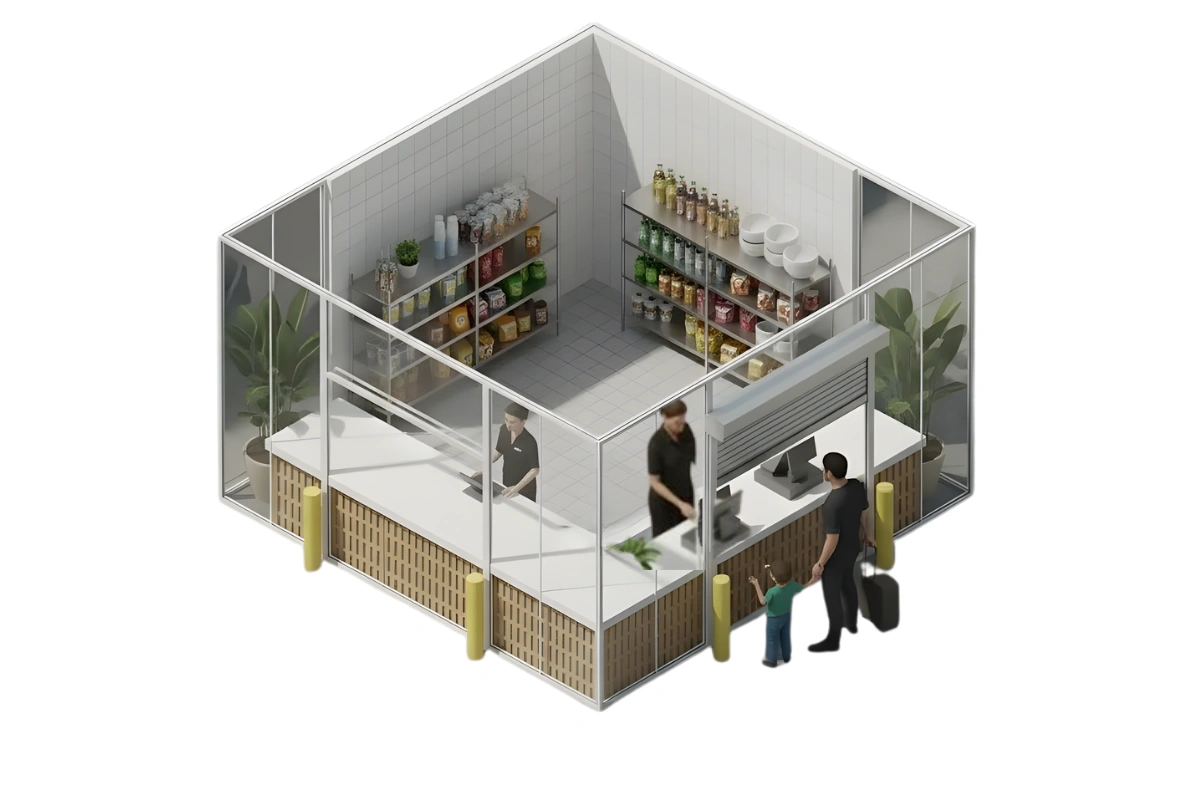
Photo Gallery