
OVERVIEW
An automated machine safety door is perfect for separating different facility compartments while allowing quick and easy access. You can create a safe working environment by using the door to isolate specific operations and materials. The option to add additional machine guard panels further improves security and makes it harder for any dangerous materials to pass through.
Safety Is Priority Number One

Safety Sensors
The sensors are available with different control system options. They can easily detect any interference. The list includes a traveling photo eye which monitors the bottom edge, a fixed photo eye which senses movement while the door is closed, and a fixed 40” light curtain. The hold-down switch will latch the door while closed. The automated machine safety doors have a traveling photo eye which can stop any operations in a moment’s notice.
Automated Roll Up Doors That Protect

Time Efficient
Often, the problem with such doors is they are slow to move. Passing through the portal would take more time, and that will result in less time working on the production processes. However, we take these issues into consideration. The opening and closing speeds of our safety doors are impressive. They make movement easy and save you valuable time. The end goal is to improve production efficiency while offering security.

High Safety Standards
There is an option to use a transparent window for observation purposes. While the main reason for using such doors is to isolate a specific area of a facility, there is no harm in being able to clearly see through the door. OSHA has recommendations on specific windows you can use. Contain hazards such as small debris, dangerous smoke, intense lights, and sparks with ease. There are also different options if you want to change the visual appearances of your safety door.
High Speed Door Automation
Benefits
- The doors are easy to install. The modular system is mostly ready for work by the time it arrives. It requires little maintenance, no cutting, no drilling, and there are optional steel plates
- They are freestanding. There is no need to lean back on a wall or nearby equipment
- The system is simple. Set up, use, move, and re-use with ease. Time efficient and cost-effective
- The doors are extremely durable. With a 44” per second standard speed, the door can achieve up to two full cycles per minute. It can work for hours and can last for hundreds of thousands of cycles
- Flexibility is key. You have the freedom to adjust the covers and add different accessories
- Safety. The doors are retained in columns. What that means is the chances of someone falling off a closed door are slim. The doors are also OSHA approved
Common Applications
Machine guarding doors are great for work cells where materials and people need quick access. Ideal for automation engineers, machine builders, and facility members that need a door designed specifically for rapid access. They can be configured in many different ways.
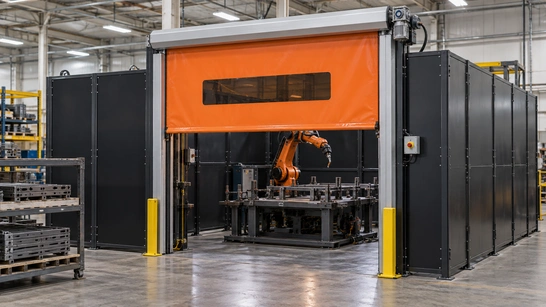
Robotic Welding Cells
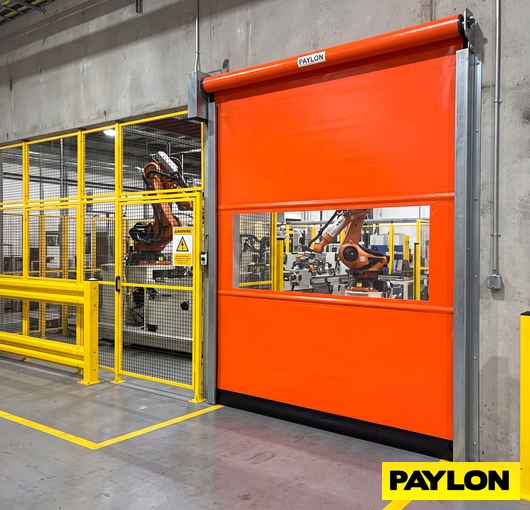
The machine guarding doors provide an operable up-and-down barrier at robotic welding cells and material loading points. They can be equipped with viewing windows for protection as it relates to welding processes by the robots. They can also feature interlocks, which prevent unsafe operation, which could cause bodily harm.
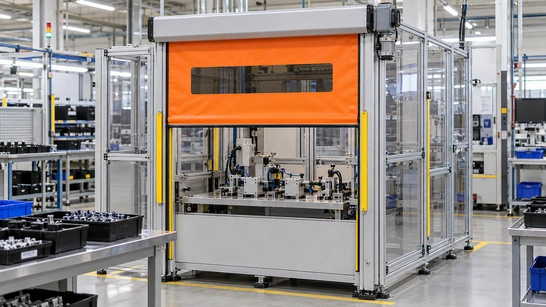
Automated Assembly Stations
Automated assembly safety doors separate loading positions from forklifts during the production cycle. They are programmed in such a way that they work with the flow of material in and out of the area as it relates to loading and unloading and operator access.
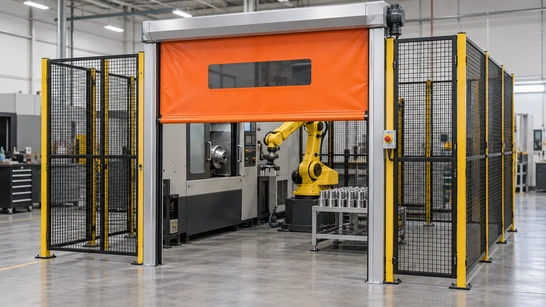
Robotic Machine Tending
Machine tending working cells require access for raw stock material, finished parts, and tooling. The roll-up machine guard door helps keep the opening area available without needing a swinging door. For planning purposes, you would review the robot's reach and the area loading routine.
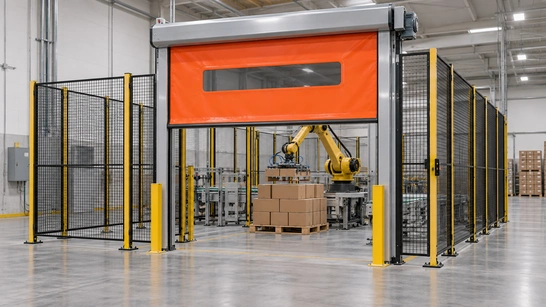
Robotic Palletizing Cells
Palletizer guarding doors are well suited for the full load of material moving through the opening. These doors roll up and down in front of a palletizer to keep people out of the area, which would put them into a dangerous situation.
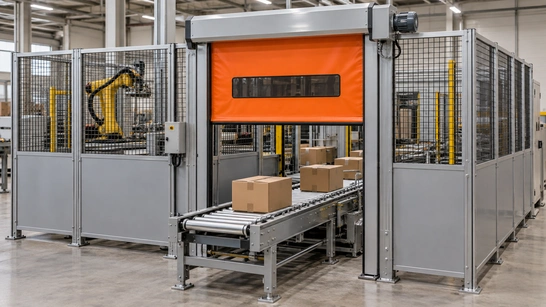
Conveyor Transfer Openings
A conveyor guarding door is a door that is located in front of a conveyor opening where material is generally fed into the conveyor. It can be tied to photo switches, interlocks, and other safety devices. Special consideration needs to be taken to make sure the load fits properly through the automated conveyor guarding door opening.
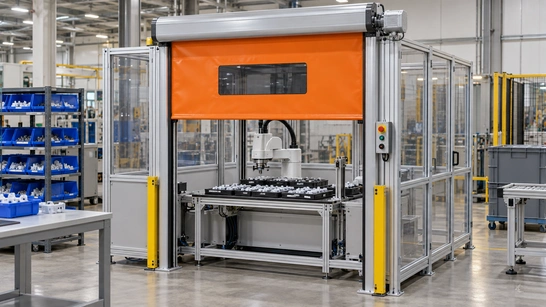
Pick-And-Place Automation
Pick-and-place work cells generally need frequent access to their trays and fixtures. With an automation cell door you can provide that access with rapid up-and-down automation that won't slow down the work process. This increases replenishment and changeover speeds.
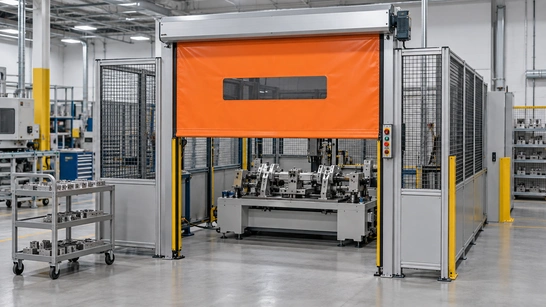
Operator Loading Stations
If safety is a key concern, then interlocked machine access doors are the ideal solution. These doors are typically programmed with an Allen-Bradley controller, photoeyes, and proximity switches to prevent operation unless all conditions are met.
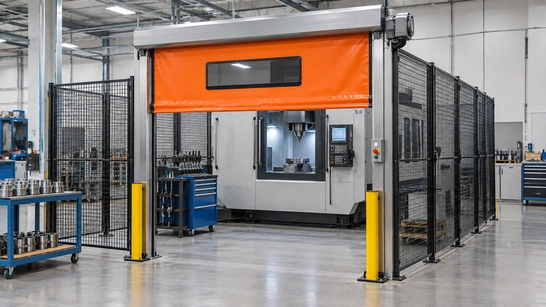
Machining Work Cells
If you have flying chips, coolant, and even a potential for ejected parts, then a machine cell safety door is a great solution. These doors keep debris and overspray contained in the working cell to keep the outside area clean and safe for pedestrians.
Machine Safety Door Questions
It's important to plan for your opening and also the operating sequence, along with machine safety interfaces, before choosing your door configuration.
Who Typically Specifies A Machine Guarding Door?
The person who typically specifies a machine guarding door would be the automation engineer or a robot integrator who is designing the workcell. If the workcell is already installed, then sometimes the manufacturing and/or maintenance person would work closely with PAYLON to integrate the roll-up machine door.
Can The Door Work With Existing Machine Controls?
Yes, the door can work with existing machine controls. PAYLON does not do on-site installation, connecting the controls to your existing controls; however, we do have access to third-party installers who can work with these interlocks and perform the wiring and safety logic as needed.
Is A Photoeye The Same As A Safety Interlock?
No, a photo eye is not the same as a safety interlock. The safety interlock ensures that a device is fully closed, which would complete a machine safety circuit, sending an electrical signal. Think of it like a gate that you shut to your front yard that has a small switch. When the gate is shut, it would send a signal to the control panel. A photoeye is a visual indicator. You could think of that like the photoeye at the bottom of your garage door. If you put your foot under the garage door, it breaks the photoeye beam and sends a signal to the control panel.
How Much Mounting Space Is Needed?
The amount of space needed above your machine roll-up door should be adequate so that if there is a slight variation in the load, it would not hit the top of the door. You want to keep your tolerances large enough that it can account for human error (if it is being loaded by an operator) or mechanical error if loaded by automation.
How Do I Specify The Operating Frequency?
It's important that you inform us how often the door is going to be raising and lowering. That will determine the motor that is used, along with the materials and components such as bushings, belts, and gears. We will want to know how often it cycles every hour and how many shifts there are (for instance, day shift, night shift) and then we can extrapolate the duty cycle we need for proper ordering.
Can I Use A Viewing Window For Welding?
Yes, you can have a viewing window for welding robot cells as they relate to the roll-up door; however, it's important to note that these windows are not a substitute for a welding helmet. They are simply supplied as a feature on the door that you could quickly glance at and then glance away.
Can The Door Be Freestanding?
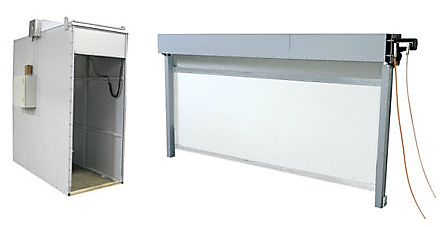
Yes, the machine doors can be freestanding, which is to say they are not supported by the structure around them. We supply the freestanding frame along with the door for a complete turnkey installation.
What Should I Send For A Quote?
For a proper quote, ideally we would have you provide dimensions, photos, even a layout sketch, and a brief description of your process, including frequency of operation, your available power, the type of controls you are looking for, and any relevant hazard information. Also, we would like to know how people will enter and exit the work cell and where you want the motor, as far as the right side or the left side of the frame.