

Choose The Right Insulated Door
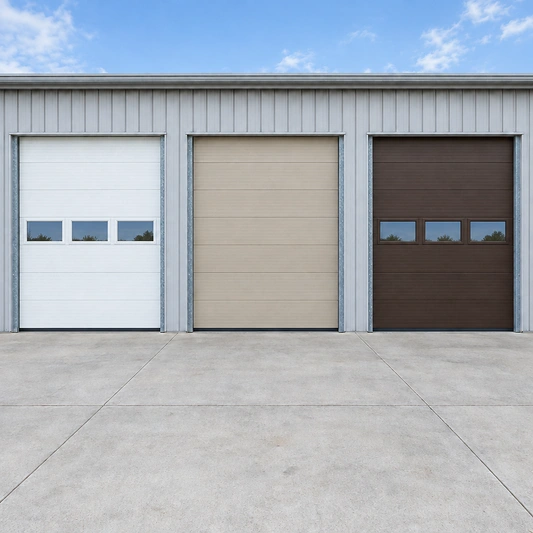
Insulated commercial garage doors are sectional doors made of steel, crafted with a foam core that retains heat inside and blocks outside noise. We offer five variants and have ratings ranging from R-10 to R-26.
Choose based on how much insulation is required, the width of the opening, and the extent of door usage.
Not sure what door to choose? Provide us your opening size and some photos, we will assist in reviewing the details.
Choose From Five Insulated Door Types
Five door types. Five levels of insulation. Start with how much heat you need to keep in.
 1
1Standard Insulated
Doors
Lower-Cost Insulation
A 2-inch door with a polystyrene foam core and rated R-10.29.
Select This If: You want to economize and need insulation on a large opening.
 2
2Slim Polyurethane
Doors
Thinner, Better Insulated
A 1-½ inch polyurethane door and rated R-13.68.
Select This If: Your choice is white or black and you have a smaller heated facility.
 3
3High-Efficiency Insulated
Doors
Heated Or Cooled Buildings
A 2-inch polyurethane door, has a thermal break feature, and rated R-17.54.
Select This If: You need the door size up to 40 feet wide and alternately heat or cool the building.
 4
4Heavy-Duty Insulated
Doors
Dent-Resistant Face
A 2-inch polyurethane door with a 20-gauge steel facade and rated R-17.54.
Select This If: The door is impacted by carts, forklifts or trucks.
 5
5Maximum Insulation
Doors
Highest R-Value
A 3-inch polyurethane door and rated R-26.89.
Select This If: Your largest expense is energy depletion through the door.
Every door is made to size with steel on both faces and foam in between. We can help you match the R-value to your building.
Standard Insulated Doors

A 2-inch steel door with built-in polystyrene foam core. It is the most economical way to insulate a large opening and can fit up to 28 feet wide in opening size.
Best For
- Warehouses and manufacturing plants
- Large openings that need some insulation
- Projects on a tight budget
R-Value
R-10.29
Thickness
2 in
Max Size
Up to 28'2" W x 28'0" H
Steel Face
24 or 26 gauge
Key Features
- Polystyrene foam core, CFC-free
- Micro-grooved or flush face with a woodgrain texture
- Concealed steel back-up plates for strong hardware mounting
- Double bottom seal and a gasket between sections
- Optional windows in 24 x 6, 24 x 12 or 34 x 16 in frames
Window Options

Slim Polyurethane Doors

A leaner 1-½ inch door with polyurethane foam core and a thermal break. Provides better insulation than the polystyrene door while staying lightweight.
Best For
- Smaller heated shops and garages
- Fire and ambulance stations
- Openings up to 24 feet wide
R-Value
R-13.68
Thickness
1-1/2 in
Max Size
24'2" W x 20'0" H
Steel Face
27 gauge
Key Features
- Polyurethane foam with a thermal break
- Micro-grooved or flush face
- White or black finish
- HFC-free foam that meets the IECC energy code
- Optional window frames (full-view aluminum sections not offered)
Window Options

High-Efficiency Insulated Doors

A 2-inch polyurethane door with a thermal break that retains inside heat. It can accommodate an opening range of up to 40 feet wide and offered with the most finishes.
Best For
- Heated or cooled warehouses and factories
- Truck terminals
- Wide openings up to 40 feet
R-Value
R-17.54
Thickness
2 in
Max Size
Up to 40'2" W x 20'0" H
Steel Face
26 gauge
Key Features
- Polyurethane foam with a thermal break
- Micro-grooved or flush face
- White, six factory colors or 188 powder coat colors
- Full-view aluminum window sections available
- Custom logo printing available
Window Options

Heavy-Duty Insulated Doors

A 2-inch polyurethane door with a dense 20-gauge steel facade that can withstand dents from carts, forklifts, and trucks.
Best For
- Busy loading docks
- Service bays and fire stations
- Doors that take regular knocks
R-Value
R-17.54
Thickness
2 in
Max Size
20'2" W x 24'0" H
Steel Face
20 gauge
Key Features
- 20-gauge exterior and 27-gauge interior steel
- Polyurethane foam with a thermal break
- Micro-grooved face
- White or 188 powder coat colors
- Custom logo printing available
Window Options

Maximum Insulation Doors

Our sturdiest door with 3 inches of polyurethane foam and a thermal break. It boasts the highest R-value in the range, ideal for buildings where heat dissipation has the largest expenditure.
Best For
- Climate-controlled facilities
- Heated or cooled agricultural buildings
- Buildings in very cold or hot climates
R-Value
R-26.89
Thickness
3 in
Max Size
Up to 40'2" W x 20'0" H
Steel Face
26 gauge
Key Features
- 3-inch polyurethane foam with a thermal break
- U-factor of 0.12
- Micro-grooved face
- White, sandstone or brown finish
- Optional window frames (full-view aluminum sections not offered)
Window Options

How To Measure Your Opening
Use a measuring tape and measure in inches. Note the numbers and input them on the quote form. If anything is not clear, provide photos of the opening, the wall on top, and the inner ceiling. We will review the details for you.

Five Measurements
- A. Width - measure the opening from jamb to jamb. Check the top, middle and bottom, and use the largest number.
- B. Height - measure from the floor to the underside of the header. If the floor slopes, measure both sides.
- C. Headroom - measure from the top of the opening to the ceiling or the lowest pipe, light or beam. The springs and the curve of the track sit here.
- D. Side room - measure the clear wall on each side of the opening. The vertical tracks mount here.
- E. Backroom - measure from the opening straight back into the building to the nearest wall or obstruction. The open door rests along the ceiling in this space.
Track And Spring Options
Track Size
2 or 3 in
Track Radius
12 or 15 in
Springs
10,000 cycles minimum
Seals
Double bottom seal standard
The clearance and rear area depend on the door height and type of track. Provide us your measurements and we will configure the track according to your opening and confirm exact clearances with your quote. For busy doors, high-cycle springs are available.
Track Mounting
Tracks have various mounting methods such as using a bracket, clip angle, or mounted on a steady angle depending on your wall. Unsure what fits your opening? Select “Not Sure” on the quote form, then add a photo. We will recommend what is suitable.
Color Options
Each insulated door comes in white color. We have factory colors for most models. 2-inch powder coated doors are available in 188 colors. Review the list below for each door type specification.

White
Standard on every model.

Almond
A soft cream that suits brick and stucco.

Sandstone
A warm gray-tan for earth-tone buildings.

Brown
A dark brown that hides dirt well.

Gray
A neutral gray for metal and block walls.

Black
A clean, modern look. Graphite is also offered on some models.

Custom Powder Coat
Choose from 188 colors to match your building or brand.
Finishes By Door Type
- Standard Insulated - white or 188 powder coat colors, plus six factory colors on 26-gauge models
- Slim Polyurethane - white or black
- High-Efficiency - white, six factory colors or 188 powder coat colors
- Heavy-Duty - white or 188 powder coat colors
- Maximum Insulation - white, sandstone or brown
Insulation And R-Value
Each door has a foam core within two steel surfaces. The foam reduces the flow of heat passing through the closed door, so in the winter the building stays warmer and remains cooler in summer. The R-value and U-factor are two numbers that validate its efficiency.
Compare The Five Doors
| Door Type | Foam | Thickness | R-Value | U-Factor |
|---|---|---|---|---|
| Standard Insulated | Polystyrene | 2 in | R-10.29 | 0.29 |
| Slim Polyurethane | Polyurethane | 1-1/2 in | R-13.68 | 0.19 |
| High-Efficiency | Polyurethane | 2 in | R-17.54 | 0.19 |
| Heavy-Duty | Polyurethane | 2 in | R-17.54 | 0.19 |
| Maximum Insulation | Polyurethane | 3 in | R-26.89 | 0.12 |
Polystyrene Vs. Polyurethane
- Polystyrene foam is used in the Standard Insulated doors. It costs less and gives R-10.29 in a 2-inch door.
- Polyurethane foam is used in the other four door types. It insulates better for the same thickness, with R-17.54 in a 2-inch door.
- Polyurethane doors have a thermal break, which stops cold passing straight through the steel from outside to inside.
- The polyurethane foam is CFC and HCFC-free, and these doors meet the IECC energy code.
What The Numbers Mean
R-Value
How well the foam resists heat flow. Higher is better.
U-Factor
Heat flow through the whole door section. Lower is better.
Thermal Break
On polyurethane doors. Keeps cold from passing through the steel.
Sound
Every model is rated STC 21.
R-values are calculated to ASTM C518. U-factors are tested to DASMA 105.
How Much Insulation Do You Need?
Choosing the highest R-value is not always correct. More insulation is required if the building is heated or ventilated, in extremely hot or cold climates, and a door that remains closed throughout the day. An open door for half of the day loses heat regardless of its R-value. So a cost-effective door will be more appropriate in that case. Inform us how frequently the door opens, we will come up with a proposed door.
Pricing And Warranty
Request A Quote
Pricing For Your Opening
Door size, insulation, steel gauge, finish, and windows are factors that influence the price. Provide us the opening dimensions so we can offer the right door.
Review the quote for delivery, installation, an operator, and taxes. A single price does not represent all five door types.
Warranty Coverage
10-Year Door Warranty
Every insulated door in this section has a warranty of 10 years. Documented terms are included in your quote.
Tested Performance
R-values are calculated to ASTM C518. U-factors are tested to DASMA 105.
Each model is rated STC 21 for sound, and the polyurethane doors attain the IECC energy code.
Insulated Garage Door Questions
Quick answers to the questions we hear most.
Which insulated door should I choose?
Begin on how you alternately heat or cool the building. Polystyrene doors cost less, polyurethane doors have better insulation. The 20-gauge door can withstand dents, and the 3-inch door has the highest R-value. Unsure what to choose? Select “Not Sure” on the quote form and we will come up with a recommendation.
What is the difference between polystyrene and polyurethane?
With the same thickness, polyurethane doors have greater insulation. A 2-inch polyurethane door has a rating of R-17.54 in contrast to a 2-inch polystyrene door that has a lower rating of R-10.29. Polyurethane doors additionally include a thermal break that blocks heat from penetrating the steel.
What does R-value mean?
The R-value rating measures how effective the door prevents the flow of heat. A higher number retains more heat inside during winter and removes the warm temperature during summer.
Can I add windows?
Yes. Each model has window frames measured as 24 x 6, 24 x 12, or 34 x 16 inches, and comes in a plain or tinted glass. Aluminum sections with a full-view are available on the majority of 2-inch models.
Can I get a walk-through door in the garage door?
Yes. A walk-through door can be fabricated into a 2-inch door so people can pass through without opening the entire door. It is not ADA or egress compliant and needs around 15 inches of clearance.
Are these doors wind rated?
Wind-resistant doors are in stock on selected door models. Share the wind rating on your plans and we will recommend the corresponding door.
How much does an insulated door cost?
Door size, insulation, steel gauge, finish, and windows are factors that influence the price, so each door has its own unique quote. Verify your quote inclusions such as delivery, installation, an operator, and taxes.
What warranty comes with the door?
Every insulated door in this section has a warranty of 10 years. Documented terms are included in your quote.


Related Products

Powered Roll Up Vinyl Doors

Manual Roll Up Vinyl Doors

High Speed Roll Up Vinyl Doors

Side-To-Side Roll Up Vinyl Doors
Salt Storage Roll Up Vinyl Doors